

The Free Man - Lost, Not Broken
Why I wrote Lost, Not Broken
I didn't set out to write a book. I set out to survive a Tuesday.
Between 2015 and 2020 I lost the version of myself I thought I was. Redundancy. Divorce. Financial collapse. Depression.
All while I was, on paper, doing better than ever — Global Director of Talent Acquisition for a FTSE 250 business, a team of 250-odd people across multiple countries, the kind of job title that makes people nod approvingly at dinner parties.
Nobody at those dinner parties knew what it cost me to show up smiling.
I was the master of the mask. Energy in every meeting, purpose in every email, and underneath it, a man quietly falling apart. That's not a metaphor — that's just what carrying too much for too long does to you. You don't collapse all at once. You go numb in instalments.
It caught up with me on a cold February morning in 2020, on the M25. I won't turn that morning into a story with a neat bow on it, because it didn't feel neat. It felt like the floor giving way. What brought me back wasn't a plan or a five-step programme — it was one phone call, and the sheer bloody-minded honesty to admit I wasn't coping.
Lost, Not Broken is what I built on the other side of that.
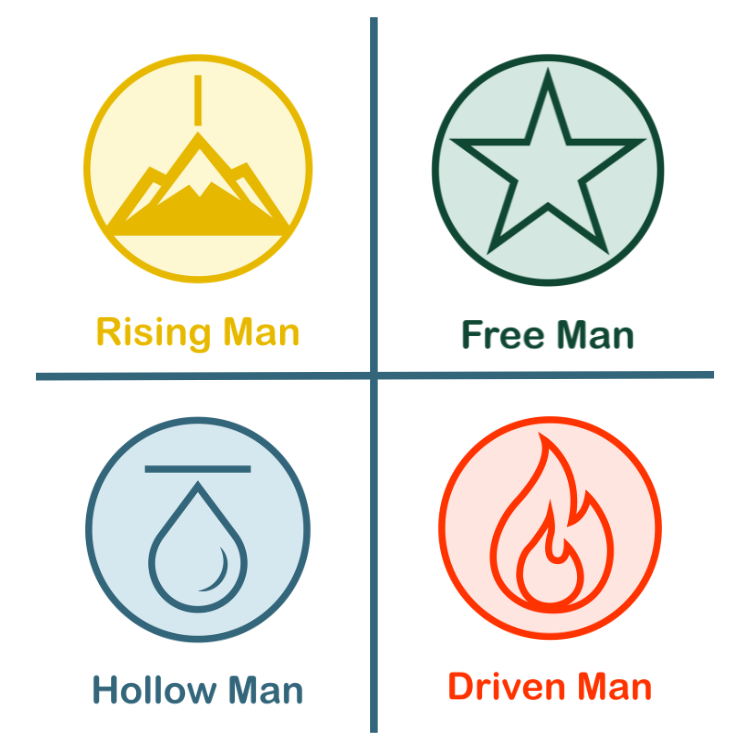
It's short — I wanted it to be something a man could actually finish, not another book that sits on the shelf making him feel guilty. It tells the story I've just told you, in more honest detail than I've ever put in front of strangers. And it lays out the model that came out of it — the four archetypes: Hollow, Driven, Rising, Free. Not a ladder you climb once and stay on top of, but a mirror. Four positions you can move between, sometimes by choice, sometimes because life throws you across the board overnight.
The title matters to me more than anything else in it. Lost, not broken. Because that's the lie the mask tells you — that if you've lost your way, something in you is fundamentally faulty and needs fixing. It isn't. You're not broken. You're a man who's carrying too much, in the wrong place on the model, who needs to find his way back. That's a completely different problem, and it has a completely different solution.
If any of this sounds familiar — if you're the man who has it together on the outside and isn't sure what's underneath any more — start with the book. It's the cheapest, lowest-pressure way in. Read it, see where you land on the model, and then decide what you want to do about it.
Book can be purchased on kindle & paperback via Amazon:


Comments